Response to Stimuli: Prose poetry and Translation
- Aarushi

- Mar 8, 2019
- 3 min read
Creativity is a response. It comments on culture, thoughts, politics, news, art and so on. Creativity also reflects. This element of reflection and response was encouraged in my Experimental Poetry module.
An aspect of free-writing was introduced. Free-writing is probably one of the easiest forms of writing for me. Taking inspiration from films, books, music, painting, design, photograph, you name it and I’ll give it a shot. I could either write about it or create something from it. I could respond and react or comment and create. I enjoyed free-writing and in fact realised I’ve been using it for my Instagram blog more often that I realised.

As Writer’s Digest article on free writing suggests, I have used timed as well as unlimited time writing. My work differs in each case. Of course, with less pressure, there are less mistakes and more creativity. In our workshop, we were given five to ten minutes per free-writing session followed by five minutes of either sharing the idea or reading the piece out loud. I generally liked reading my work as I could get feedback immediately.


For the second week in the module, we experimented with colours in our writing. I chose the colour Yellow for my writing. In my family every child has a dedicated stone to them, my sister’s stone is ruby and mine is yellow-opal, which is why I chose the colour for the prose writing week.
To get inspired for my writing I researched the meaning of yellow colour

In the following week we experimented with Synesthetic. Poetry Foundation suggests that synaesthesia deals with using our senses to write description. We used sounds as a stimulus for writing. I used this idea over the weekend and recorded the sounds of birds singing in Hampton in Arden whilst walking in a pedestrian path next to a small forestry.
The prose poem written for this week was brought to the following class for receiving feedback.

An interesting perspective brought to our notice during the translation week. Translation didn’t necessarily mean linguistic translation, which of course is the most popular form. It could also be narrative translation, for instance, poem to prose or vice versa, prose to play, poem to play, novel to screenplay and so on.
The lecture was on Radical Translation and we looked at Linguistic, Technological, Formal and Generic translations. We discussed the issue of ‘lost in translation’ and realised that from one context to another the deeper meaning of the subject is usually conveyed even though some details might be lost.
In the following sample from my classwork is an attempt to use a folklore from India that has been compared to a contemporary news with a twist. The folklore was then summarised to see parallels in their narrative.


Kim Heyesoon created a list of magic words. These are words that she either frequently uses or are themes in her writing. We were encouraged in class to do the same. Following are my magical words:
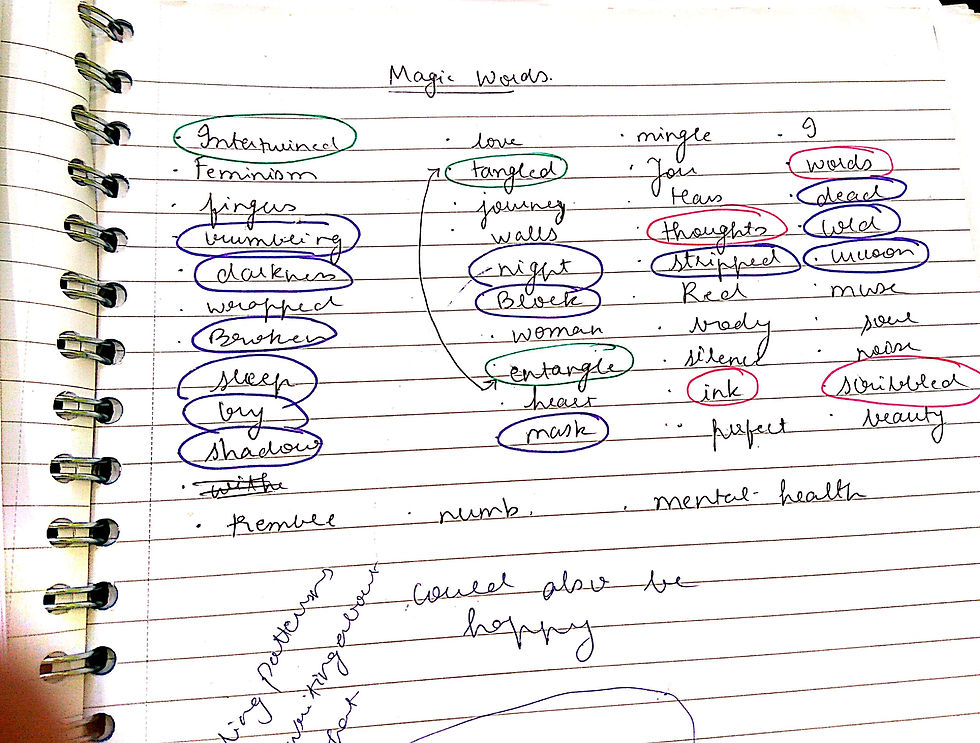
We will be looking at these words in week 10
We then applied our knowledge on translation and interpreted Odyssey for re-writing it.
I wrote my poem in the perspective of Circe who transforms the sailors into pigs to save her honour.

We then looked at Ekphrastic Poetry. According to Poetry Foundation, ekphrasis is a Greek term which means writing about art with vivid description. We looked at many art magazines and used paintings and images for writing about poems. Later in the lesson we looked at Imagism and considered Erza Pound’s tips on writing an Imagist Poem. She suggests that we must consider Object–Image–Development, to have imagery in poems.
Following is an example of a poem I wrote in class:

I have enjoyed working on experimental poetry and would like to try more forms in the coming weeks.

Comments